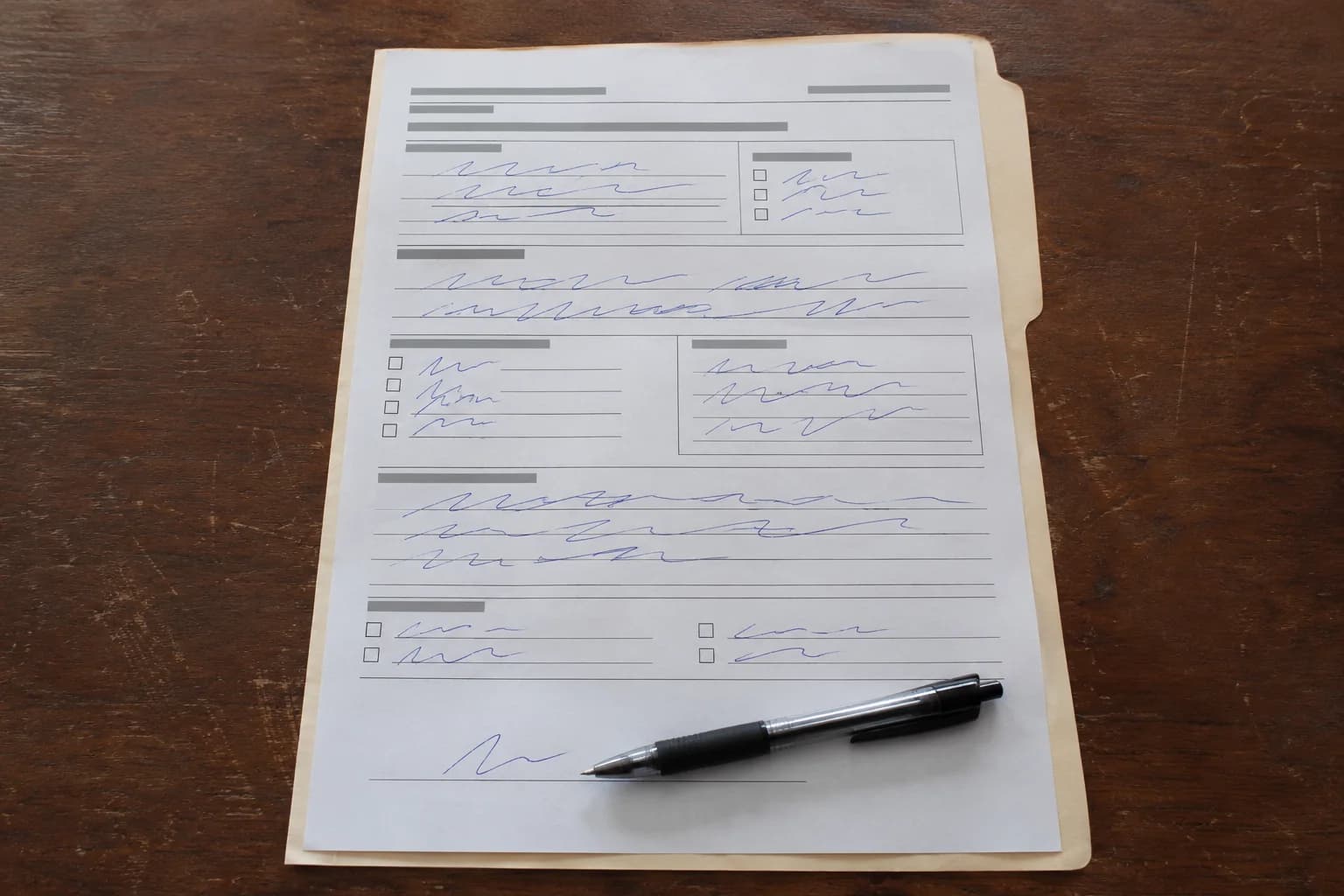
A proof of service is the sworn statement that tells the court how, when and where papers were delivered. In California the right form depends on two things: whether the papers include a summons, and what kind of case it is. A civil summons always goes on POS-010. Family law and small claims have their own versions.
Every form below was read on courts.ca.gov in October 2026. The revision dates are the ones printed at the bottom of each form. Several change on January 1, 2027; see what changes on proofs in 2027.
Which California proof of service form do I need?
For a civil summons and complaint, use POS-010; for civil papers served later in the case, use POS-020 (personal delivery), POS-030 (first-class mail) or POS-040 (other methods). Family law uses FL-115 for the summons, and small claims uses SC-104 for the Plaintiff's Claim.
| Form | Use it for | Case type | Mandatory or optional | Current revision |
|---|---|---|---|---|
| POS-010, Proof of Service of Summons | A summons and complaint, by any method | Civil | Mandatory | Rev. January 1, 2007 |
| POS-015, Notice and Acknowledgment of Receipt, Civil | The form mailed with a summons under CCP § 415.30, signed by the person served | Civil | Mandatory | Rev. January 1, 2005 |
| POS-020, Proof of Personal Service, Civil | Papers handed over after the case starts (not a summons) | Civil | Optional | New January 1, 2005 |
| POS-030, Proof of Service by First-Class Mail, Civil | Papers mailed after the case starts (not a summons) | Civil | Optional | New January 1, 2005 |
| POS-040, Proof of Service, Civil | Papers served after the case starts by personal delivery, mail, overnight delivery, messenger or fax | Civil | Optional | Rev. January 1, 2020 |
| POS-050/EFS-050, Proof of Electronic Service | Papers served electronically | Civil | Optional | Rev. February 1, 2017 |
| FL-115, Proof of Service of Summons | A family law, parentage or custody and support summons and petition | Family | Optional | Rev. January 1, 2021 |
| FL-117, Notice and Acknowledgment of Receipt | The family law version of the mailed acknowledgment | Family | Optional | Rev. January 1, 2021 |
| FL-330, Proof of Personal Service | Family law papers handed over after the case starts | Family | Optional | Rev. January 1, 2012 |
| FL-335, Proof of Service by Mail | Family law papers mailed after the case starts | Family | Optional | Rev. January 1, 2012 |
| SC-104, Proof of Service | A Plaintiff's Claim, a Defendant's Claim or an order for examination | Small claims | Optional | Revised January 1, 2009 |
| SC-104A, Proof of Mailing (Substituted Service) | The mailing step after substituted service | Small claims | Optional | Revised January 1, 2006 |
| SC-112A, Proof of Service by Mail | Small claims papers that may be served by mail, such as SC-105 or SC-150 | Small claims | Optional | Rev. July 1, 2025 |
SC-104B, What Is "Proof of Service"?, is an information sheet for small claims (Rev. January 1, 2026). It explains service and deadlines but isn't itself a proof.
A summons or papers served later
The biggest split is between the first service in a case and everything after it.
The summons. The first papers in a lawsuit, the summons and complaint, are proved on POS-010 in civil cases. Its title line says a separate proof is required for each party served. FL-115 does the same job in family law, and SC-104 in small claims.
Papers served after the case starts. Motions, notices and discovery go on a different form. POS-020 and POS-030 each carry the warning "Do not use this Proof of Service to show service of a Summons and Complaint." POS-040 covers several methods on one form. Family law uses FL-330 for personal delivery and FL-335 for mail.
Proving a summons on one of these later-service forms is a mistake to avoid: those forms say on their face they can't be used for it.
What the server fills in on POS-010
POS-010 is two pages. Here is what each item asks for, taken from the form itself.
- Eligibility. A statement that the server was at least 18 and not a party when the papers were served.
- Documents served. Checkboxes for the summons, complaint, ADR package, civil case cover sheet (complex cases), cross-complaint and other documents.
- Who was served. The party's name as shown on the documents and, for a business or agent, the person who received them and their relationship to the party.
- Address where the party was served.
- How service was made. Personal service with date and time, substituted service, mail with notice and acknowledgment, mail to an address outside California with return receipt, or other means with the code section that allows it.
- Notice to the person served. Whether the defendant was served as an individual, under a fictitious name, as an occupant or on behalf of an entity, with the code section (for example § 416.10 for a corporation).
- The server's details. Name, address, phone, the fee charged and registration status.
- The signature under penalty of perjury, or a sheriff's or marshal's certification.
Substituted service details
For substituted service, item 5b needs more than a checkmark. The server records the date and time, the name and title or relationship of the adult who took the papers, and which kind of place it was: the office or business, the home, or the usual mailing address when no physical address is known.
The server also states the date and city of the follow-up mailing, which CCP § 415.20 requires, or attaches a declaration of mailing. Item 5b(5) is for attaching a declaration of diligence, describing the attempts made first at personal service.
Registration on the proof
Item 7 asks whether the server is not registered, exempt under Business and Professions Code § 22350(b), or a registered California process server. A registered server gives the registration number and county. Current law requires a registrant's proof to show both (B&P § 22360). FL-115 and SC-112A ask for the same information.
Papers to serve? Attach up to 5 PDFs to one Service Request.
Who signs a proof of service
The server signs, not the party. Under CCP § 414.10, any person who is at least 18 and not a party to the action may serve a summons. That person completes the proof and declares under penalty of perjury that it is true. A California sheriff or marshal certifies the form instead of declaring.
The party or attorney usually fills in the caption, the case number and the list of documents before handing the form to the server. That part is fine. The facts of service and the signature belong to the server. Read who can serve papers in California for the rules on friends, family members and registered process servers.
Service by mail: POS-015 and the acknowledgment
A summons can be mailed under CCP § 415.30 with two copies of the notice and acknowledgment form and a prepaid return envelope. In civil cases that form is POS-015. Its text says service of the summons is deemed complete on the day the person signs the acknowledgment.
On POS-010, the server checks item 5c and attaches the signed acknowledgment. If it never comes back, there is nothing to attach, and the summons has to be served another way. Family law uses FL-117 for the same purpose.
Small claims: SC-104 and its deadlines
SC-104 starts with instructions to the server. It lists who can accept for a business: an owner, a partner, any officer or general manager, a person the business authorized, or a person authorized with the Secretary of State. The server then gives or mails the completed form back "in time for the form to be filed with the court at least 5 days before the hearing."
SC-104B sets the service deadlines for a Plaintiff's Claim. For personal service, subtract 15 days from the trial date, or 20 days if the person or business is outside the county. Substituted service needs more time: the form says 25 days, or 30 outside the county, counted using the date the server mailed the papers. It also says to file the original proof 5 days before trial.
One more small claims detail from SC-104: the court can issue a civil arrest warrant for a person who skips an examination only if the order for examination was personally served by a registered process server, a sheriff, a marshal or someone the court appointed.
Filing the proof of service
The proof does its work only once it is filed. Until then, the court has no record that the defendant was served. The party or their attorney files it, in person or by e-filing where the court allows.
When to file depends on the case type, the court's local rules and the dates the court has set. Small claims sets 5 days before trial on its forms. For civil and family cases, check the court's rules and any case management date. Our Court Filings service files proofs with California courts as a filing request. Filing the proof of service is an additional fee.
Common mistakes on a proof of service
- The wrong form for a summons. POS-020, POS-030 and POS-040 can't prove service of a summons and complaint.
- No capacity for a business. When a company is served, the proof must name the person who took the papers and their title. See how to serve a corporation in California.
- Thin substituted service facts. Missing the mailing date or the declaration of diligence leaves a gap the court will notice.
- One form for several defendants. POS-010 requires a separate proof for each party served.
- A party signing as the server. Only a non-party adult can serve and sign.
- No signature or date. An unsigned proof isn't a declaration.
What changes on proofs in 2027
AB 747 (Stats. 2025, ch. 563) changes what a proof of service must contain from January 1, 2027. For personal, substituted and posted service of a summons, the proof must include one or more photos of the site of each attempt. Each photo needs a readable stamp that automatically records the date, time and GPS or equivalent coordinates (CCP § 417.10(a)(1)).
At a home or a business, at least one photo of each attempt must show the door, or the entrance if the door isn't reasonably accessible. A server who can't get a GPS signal, or who skips a photo for safety reasons, must explain why on or with the proof (§ 417.10(a)(1)–(4)). A proof signed by someone who must register will show the number the county clerk assigned (CCP § 417.40).
The Judicial Council's meeting record lists its forms items as passed on October 16, 2026, effective January 1, 2027 (civil, family law). Going by the versions in those reports:
- POS-010 gets a new item 8 for the photo of where the papers were served, a new item 5e for posting and mailing in an eviction case, and the wider mailing options for substituted service.
- POS-012 is a new optional Declaration of Diligence. It lists each attempt and a photo of where the server tried.
- FL-115 gets the photo items too, and new optional FL-116 is the family law declaration of diligence.
- SC-104 and SC-104A pick up the new mailing options. The report doesn't add a photo item to SC-104, citing the simpler service rules for small claims.
The copies attached to the reports are marked draft, and on November 5, 2026, courts.ca.gov still served the 2007 POS-010 and didn't yet have POS-012. Check the date printed at the bottom of a form before relying on it. Read how AB 747 changes service of process in 2027.
When Valpro Attorney Services serves your papers
When we serve papers for you, the completed proof of service comes back to you with the request. Send the right blank form with the documents, or tell us the case type so the matching Judicial Council form is used. See process serving for what to send, and add a filing request if you want us to file the proof too. Filing the proof of service is an additional fee.