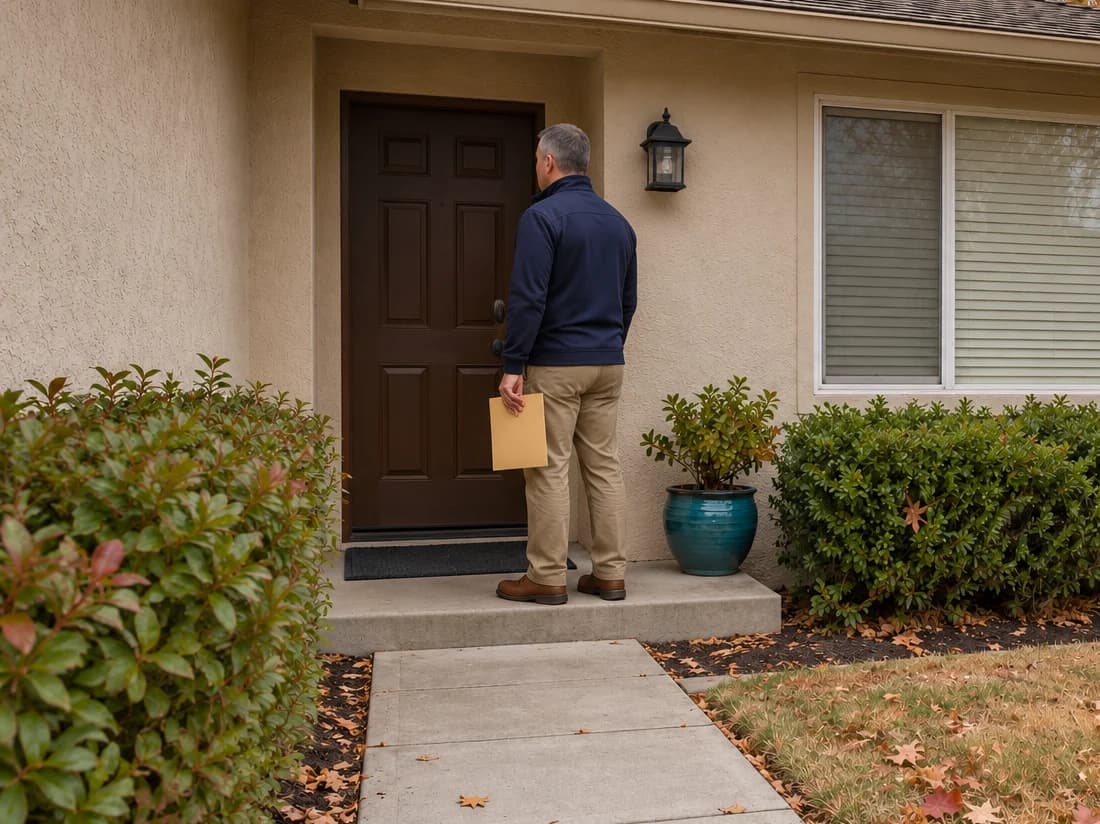
The short version
AB 747 changes three things about serving a summons in California: how hard a server must try before leaving papers with someone else, what the proof of service has to show, and how easily a defendant can undo a default over bad service. Every change applies from January 1, 2027.
The bill is the Service of Process Accountability, Reform and Equity (SPARE) Act, Chapter 563, Statutes of 2025, introduced by Assembly Member Kalra. It was chaptered, approved and filed on October 10, 2025. Its findings cite "sewer service," meaning papers reported as served that never reached the defendant.
The Legislature used a repeal-and-add structure. Each affected section has a current version that is "repealed as of January 1, 2027" and a new version that "shall become operative on January 1, 2027." The sections touched are Business and Professions Code § 22355 and Code of Civil Procedure §§ 415.20, 415.45, 417.10, 417.40, 473, 473.5, 585 and 1166, plus a new § 473.2.
Two things have happened since. AB 2042 (Chapter 379, Statutes of 2026), approved September 20, 2026, amended §§ 417.10 and 473.2 before they start. And the Judicial Council's meeting record lists its forms items as passed on October 16, 2026, with a January 1, 2027 effective date.
What changes, section by section
| What changes | Section | Before 2027 | From January 1, 2027 |
|---|---|---|---|
| Reasonable diligence before substituted service | CCP § 415.20(b)(2) | Not defined by number | At least 3 good-faith attempts at personal delivery, on 3 different days at 3 different times |
| Consumer debt cases | CCP § 415.20(b)(3) | No home-attempt rule | At least 1 attempt at the home, if known or findable with reasonable effort |
| Follow-up mailing | CCP § 415.20(a)–(b) | First-class mail | First-class mail, Priority Mail with tracking or Certified Mail with return receipt |
| Unlawful detainer posting | CCP § 415.45(d) | Diligence not defined by number | Same 3-attempt test, with 1 attempt at the home except for commercial property and Safe at Home participants |
| Photos on the proof | CCP § 417.10(a)(1)–(5) | None required | Stamped photo of the site of each attempt for personal, substituted and posted service |
| Registration on the proof | CCP § 417.40 | County of registration and number | The number the county clerk assigned |
| County register | B&P § 22355(a) | Register kept by the clerk | Register must be publicly available |
| Setting aside a default | CCP § 473.2 (new) | No dedicated motion | Motion for improper service, with the burden on the side that took the default |
| Void default judgments | CCP § 473(e) | Court may set aside void judgments | Motion to vacate a judgment void for lack of proper service "at any time" |
| Eviction complaints | CCP § 1166(a)(5) | State the notice | State the method plus the date, time and location the notice was served |
| Civil proof forms | POS-010, POS-012 | POS-010 from 2007, no diligence form | Revised POS-010 with a photo item, plus optional POS-012 for diligence |
Three attempts before substituted service
Substituted service means leaving the summons and complaint with a competent adult at the home, workplace or mailing address and then mailing a copy. California has always required reasonable diligence before that step for individuals. From 2027, the statute puts a number on it.
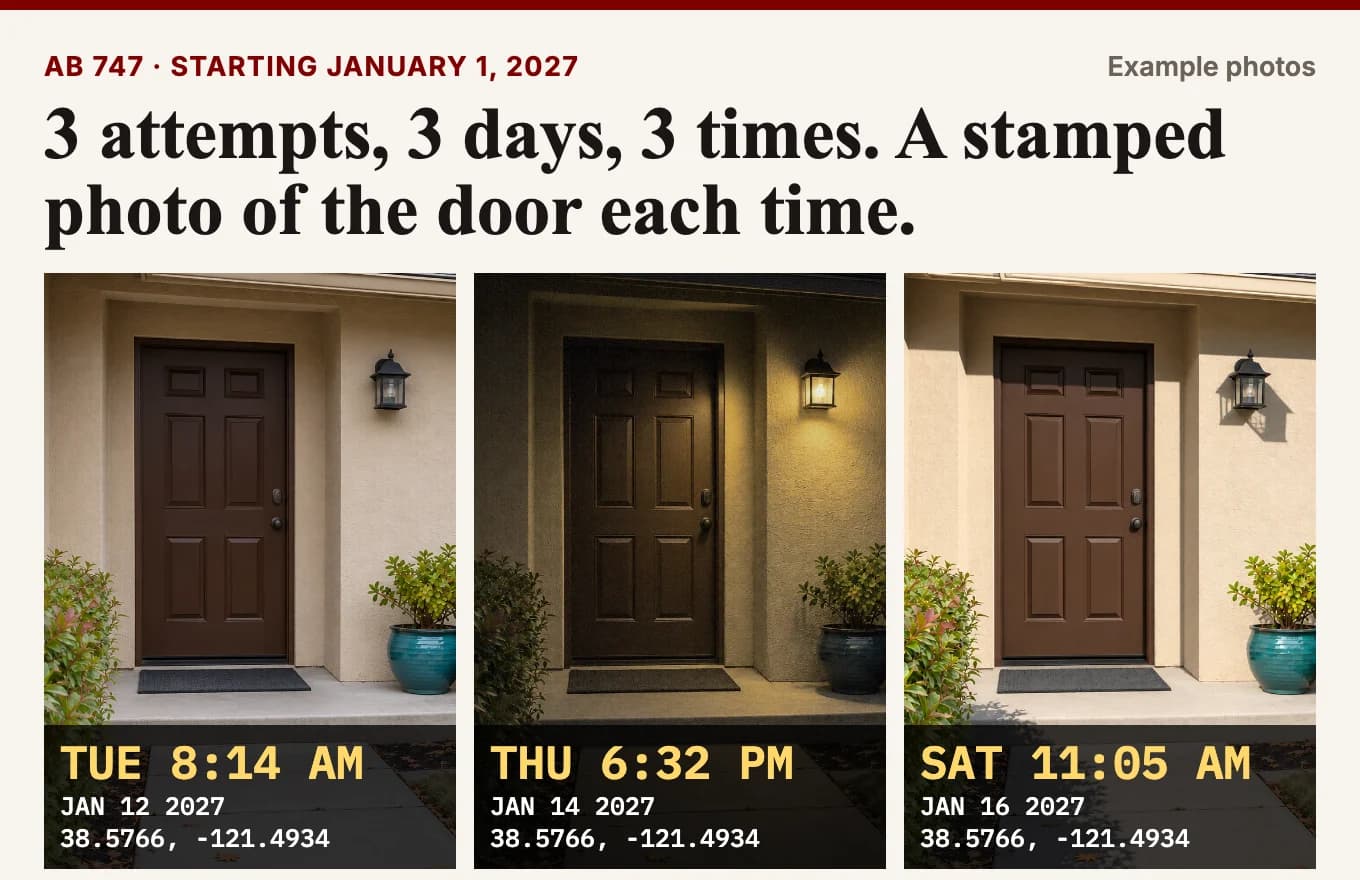
New § 415.20(b)(2) reads: "a party shows reasonable diligence by attempting personal delivery of the summons and complaint, in good faith, on at least three occasions on three different days at three different times." Three visits on the same day don't meet the test.
New optional form POS-012, Declaration of Diligence, lays this out attempt by attempt: the date, time and address, what happened, and a photo of where the server tried. It's for substituted service, and for asking a court to allow posting in an eviction case. Each server who made attempts completes a separate declaration.
Two related rules come with it. In a case to collect "consumer debt," as defined in Civil Code § 1788.2, at least one attempt must be at the person's dwelling or usual place of abode when that address is known or can be found with reasonable effort (§ 415.20(b)(3)). And the follow-up copy may now go by first-class mail, Priority Mail with tracking or Certified Mail with a return receipt.
The new subdivision (d) adds that the section "does not affect" Government Code § 6206, the Safe at Home address confidentiality program. The private mailbox rule in subdivision (c) carries over unchanged.
Posting in eviction cases
An unlawful detainer summons can be posted on the property only with a court order, after showing the tenant can't be served another way with reasonable diligence. From 2027, § 415.45(d)(1) applies the same three-occasion, three-day, three-time test to that showing.
Subdivision (d)(2) requires at least one attempt at the dwelling or usual place of abode when it is known or can be found. That home-attempt rule doesn't apply to actions for unlawful detainer of commercial real property, or to Safe at Home program participants under Government Code § 6205.5.
Photos on the proof of service
This is the change servers will feel most. New § 417.10(a)(1) says that if a summons is served under § 415.10 (personal), § 415.20 (substituted) or § 415.45 (posting), the proof "shall include one or more photographs of the site of each effected or attempted service."
What each photo must do:
- Carry a stamp. Each photo needs "a readable stamp that establishes and automatically records the date, time, and global positioning system (GPS) or equivalent coordinates." A typed caption isn't a stamp.
- Show the door at a home. At a dwelling, at least one photo per attempt shows the door, or the entrance to the house or apartment if the door isn't reasonably accessible.
- Show the door at a business. At a place of business, at least one photo per attempt shows the door or entrance of the specific office being served.
- Explain any entrance photo. If the server photographs the entrance instead of the door, the proof must explain "with specificity" why the door wasn't accessible.
- Be taken at the time. Photos are taken "as closely as practicable to the time" of the attempt.
Two exceptions exist. With no GPS, cellular or equivalent signal, the server gives a detailed statement explaining the missing stamp. And a photo isn't required if, in the server's reasonable judgment, taking it would compromise the server's safety. The server then documents the attempt and explains why.
The Judicial Council's forms report adds some practical detail:
- Which attempts need photos on the form. The report treats photos of attempted service as applying when a proof shows a service method was unsuccessful. So POS-010 asks for a photo of where the papers were served, and POS-012 asks for a photo of each failed attempt.
- Who can be in the photo. The forms say the server, the person served and anyone else don't have to appear in it.
- Small claims. The report doesn't add a photo item to SC-104, citing the simpler service rules for small claims.
- Some other papers. Rules 3.1150, 3.1160 and 3.1372 say proofs served under those rules don't need the photos.
The summaries and the statute don't read quite the same way. The Legislative Counsel's Digest summarizes the photo rule in a way that can be read as limited to unlawful detainer summonses. The operative text of § 417.10(a)(1) lists personal, substituted and posted service with no such limit, and the Council's report describes it the same way. If your practice depends on the scope, get an attorney's reading.
Papers to serve? Attach up to 5 PDFs to one Service Request.
Registration numbers and a public register
California already requires anyone who serves more than 10 papers a year for pay to register with the county clerk (Bus. & Prof. Code § 22350). AB 747 makes that registration easier to check.
From 2027, a proof signed by a person required to register, or by that person's employee or independent contractor, "shall indicate the number assigned to the person by the county clerk" (CCP § 417.40). The old requirement to name the county drops out of this section. And the county clerk must "maintain a publicly available register of process servers" (B&P § 22355(a)).
Defaults: what happens when service is challenged
New § 473.2 gives a party who wasn't served "in accordance with this chapter" a direct motion to set aside or vacate a default or default judgment, and for leave to defend or for dismissal as the law permits. The moving party offers evidence, by sworn affidavit or otherwise, that service wasn't lawful. That evidence rebuts the presumption that the facts in the process server's return are true.
The side that took the default then has to prove by a preponderance of the evidence that service was lawful. The court must take evidence and "shall not deny a reasonable request" for a hearing with oral testimony.
AB 2042 settled the timing. Section 473.2 applies to "service attempted or completed on or after January 1, 2027," and it doesn't alter a court's existing authority over a proof of service filed before that date. For returns filed before the operative date, a missing photo "shall not by itself" make the proof unlawful or insufficient.
Three neighboring sections change too:
- § 473(e): a motion to vacate a default judgment "that is void for lack of proper service" may be brought "at any time after entry of the judgment."
- § 473.5: applies when service "was lawfully effected but" didn't give the party actual notice in time to defend.
- § 585: the clerk's entry of default now calls for the plaintiff's written application "and proof of service of the summons."
AB 2042 also amended Civil Code § 1788.61 for debt buyer cases. A person who didn't get actual notice in time to defend can move to set aside a default there even if service "was lawfully effected."
The practical effect: the proof of service and the server's records may need to stand up at a hearing.
Eviction complaints must describe the notice service
From 2027, an unlawful detainer complaint must "state specifically the method used to serve the defendant with the notice or notices of termination" and "the date, time, and location of effected service of the termination notice" (§ 1166(a)(5)). A landlord can meet this by completing the service items on a Judicial Council form complaint or by attaching a proof of service of the notice. Either way, whoever serves a 3-day or other notice should record all three facts.
The eviction forms change the same day. The Council's item revises SUM-130, UD-100, UD-105 and UD-116. Under AB 863 (Stats. 2025, ch. 344), SUM-130 becomes a single summons form carrying English, Spanish, Chinese, Tagalog, Vietnamese and Korean.
What to tell your process server
For attorneys, paralegals and landlords sending service out in late 2026 or after January 1, 2027, these are the questions and details that line up with the new text:
- Photo practice. Ask how the server captures the date, time and GPS stamp, and how the photos reach the proof.
- Registration number. Ask which county registered the server and confirm the clerk's number will appear on the proof.
- Attempt log. Ask for the date and time of every attempt, so a diligence declaration or POS-012 can show 3 different days and 3 different times.
- Best times. Give at least 3 windows on different days, such as an early morning, an evening and a weekend, if the person keeps varied hours.
- Consumer debt cases. Flag the case type and give the home address, since one attempt must be made there.
- Eviction notices. Ask for a written record of the date, time and location the notice was served, for § 1166(a)(5).
- Safe at Home. Tell the server if a party may be a Safe at Home participant.
- Doors and entrances. Describe gates, lobbies or locked buildings, so the server can plan the door or entrance photo.
Court-ordered service by email: SB 85
SB 85 (Stats. 2025, ch. 403) is a separate law already in force since January 1, 2026. Under CCP § 413.30, if a plaintiff exercising reasonable diligence can't serve a summons by the authorized methods, the court may, on motion, direct service in a manner reasonably calculated to give actual notice, "including by electronic mail or other electronic technology."
The motion has to set out "all attempts to serve the defendant by each of the methods prescribed by statute" and why each failed at every address or location where the defendant is likely to be found. The section doesn't apply to actions against a governmental entity or its agents or employees. So a clear attempt record matters here too, and email service without a court order isn't what this section allows.
What to check before you file
The Judicial Council's meeting record lists the civil, eviction and family law items as passed on October 16, 2026, effective January 1, 2027. The copies attached to those reports are marked draft, and on November 5, 2026, courts.ca.gov still served the 2007 POS-010 and didn't yet have POS-012. Check the date printed at the bottom of a form before relying on it.
Related guides
- Who can serve papers in California
- California proof of service forms
- How to serve a corporation in California
- Process serving in all 58 counties
To send papers out for service, start a Service Request.
The statute text on this page was read from the California Legislature's own bulk data (pubinfo_2025.zip) on November 5, 2026, because leginfo.legislature.ca.gov blocks automated reading. Checked November 2026.